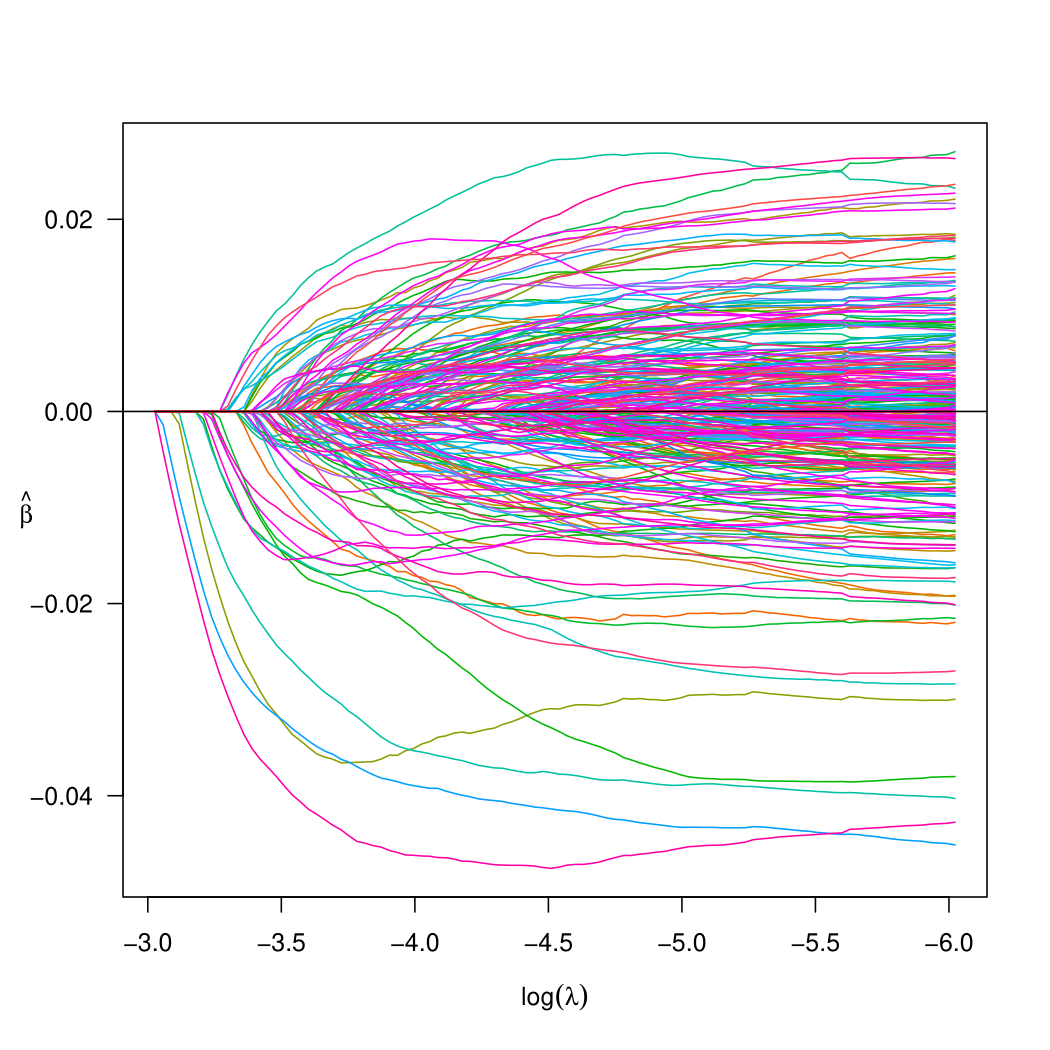
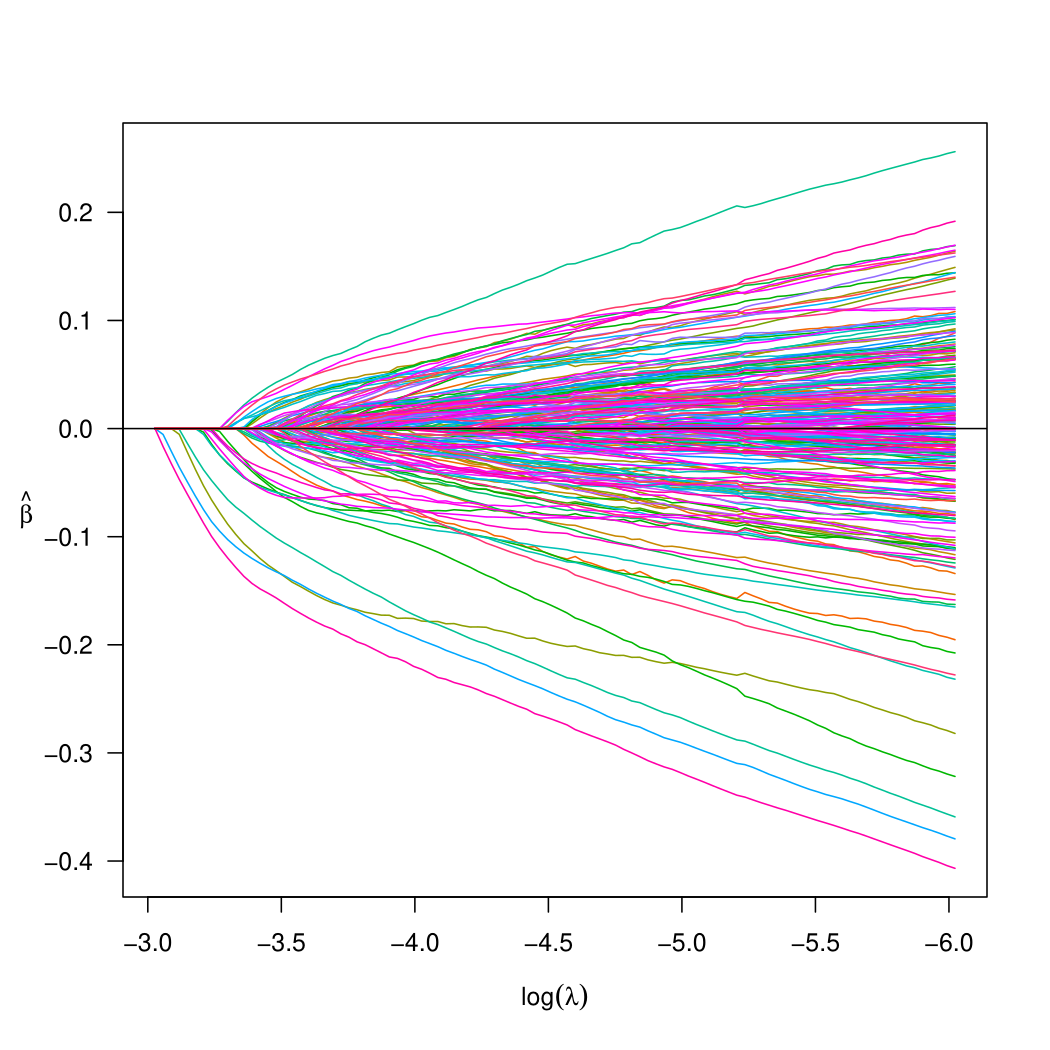
This article shows how biglasso compares to
glmnet, ncvreg, and picasso on
simulated and real data sets, covering linear regression, logistic
regression, memory efficiency, and out-of-core (“bigger than RAM”)
fitting. The code to rerun all of these benchmarking experiments lives
in a separate repository, biglasso-bench.
Screening rules
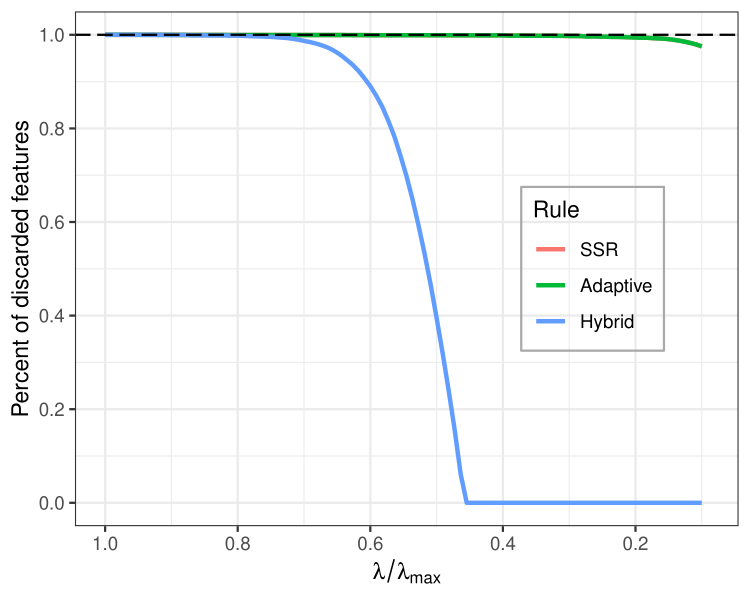
biglasso’s adaptive screening rules discard features
that provably cannot enter the model at the current lambda,
avoiding wasted work scanning the full (possibly huge) design matrix.
The figure below shows what fraction of features each rule discards
across the solution path, on the bcTCGA breast-cancer gene expression
data.
Linear regression
Simulated data
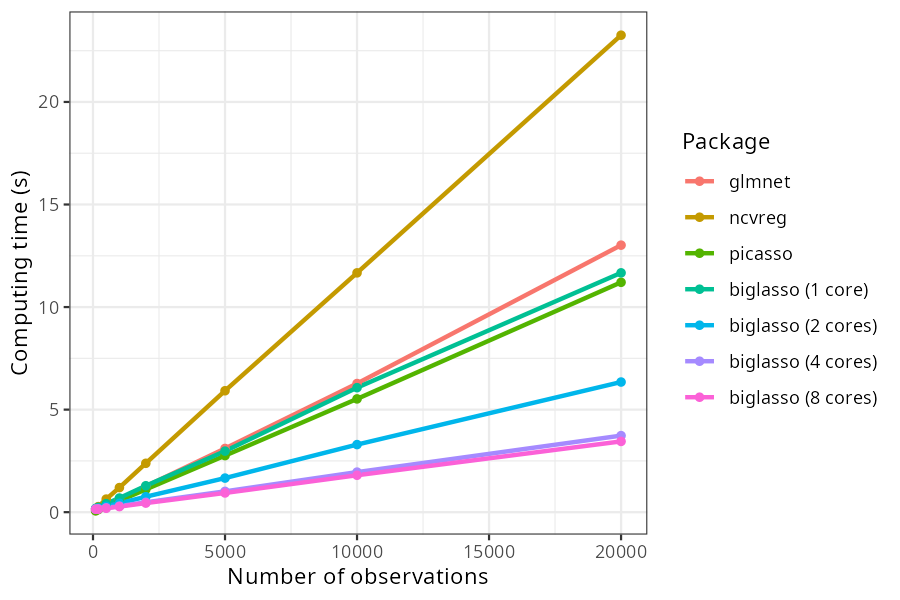
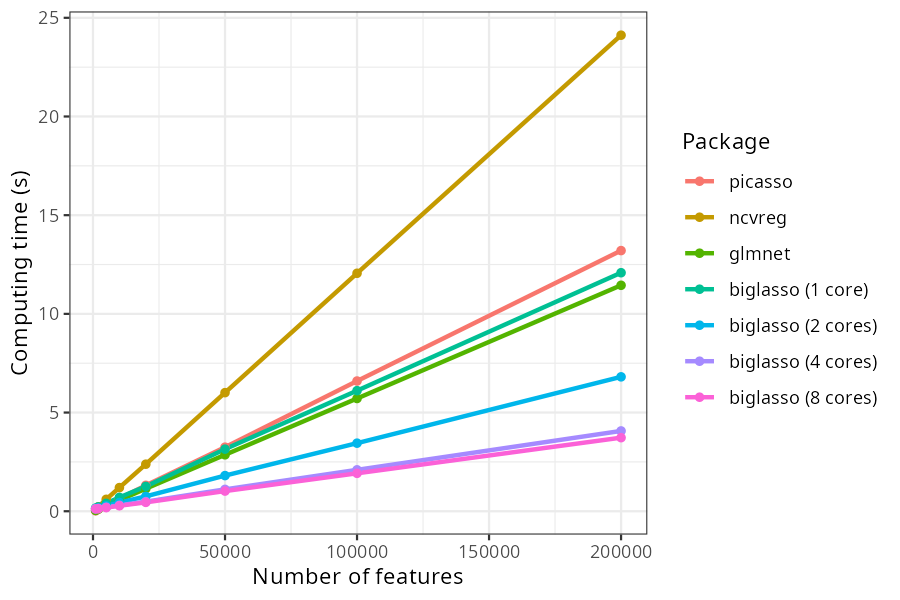
Solving the lasso path (100 lambda values, log-spaced
from lambda_max down to 0.1 * lambda_max) over
20 replications, varying the number of observations n
(p fixed at 10,000) and the number of features
p (n fixed at 1,000). Data are generated as
y = X %*% beta + 0.1 * eps, X and
eps iid N(0, 1).
- Varying
n: At the largest simulated size,biglasso(1 core) is not the fastest package here - it trailspicassoby a factor of 1.0; with multiple cores (biglasso (8 cores)),biglassois the fastest option overall, 3.2x faster than the fastest single-threaded package (picasso). - Varying
p: At the largest simulated size,biglasso(1 core) is not the fastest package here - it trailsglmnetby a factor of 1.1; with multiple cores (biglasso (8 cores)),biglassois the fastest option overall, 3.1x faster than the fastest single-threaded package (glmnet).
Real data
The same path-fitting benchmark, run on three real data sets: breast-cancer gene expression data (bcTCGA), MNIST handwritten digit images, and a resampled subset of the NYT bag-of-words corpus (see biglasso-bench’s README for exact provenance of each).
| Method | gene | mnist | nyt |
|---|---|---|---|
| glmnet | 0.53 (0.002) | 2.81 (0.016) | 15.08 (0.075) |
| ncvreg | 1.14 (0.010) | 5.67 (0.020) | 31.19 (0.016) |
| picasso | 0.62 (0.008) | 3.11 (0.026) | 18.37 (0.030) |
| biglasso | 0.67 (0.005) | 1.73 (0.080) | 17.35 (2.353) |
biglasso has the fastest mean time on 1 of the 3 real
linear-regression data sets tested here; on the others it is not the
fastest by raw computing time - glmnet was.
glmnet in particular has gotten faster since the original
biglasso paper was published, and on real data at these sizes it’s often
competitive with or faster than biglasso.
biglasso’s advantage on real data is primarily memory (see
below), not always raw speed.
Logistic regression
Simulated data
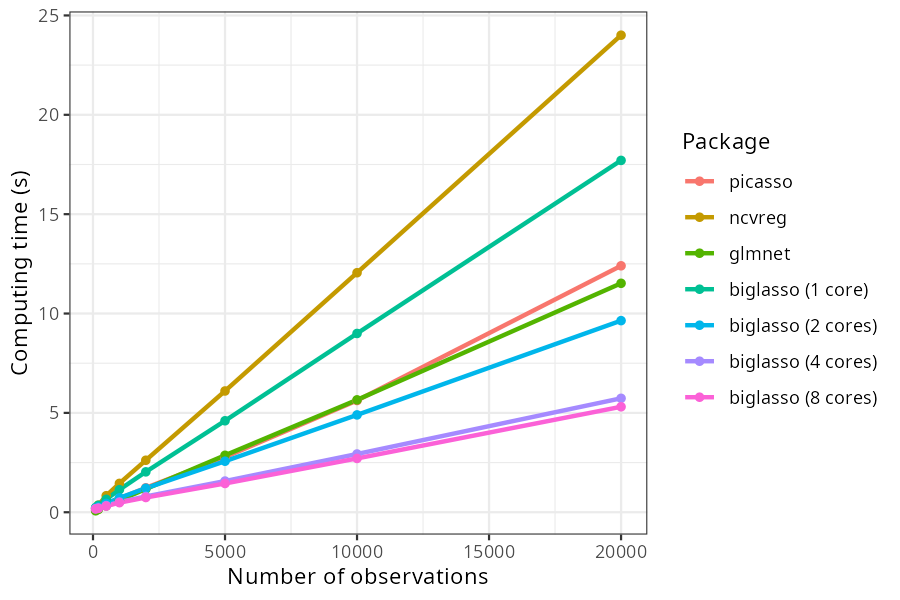
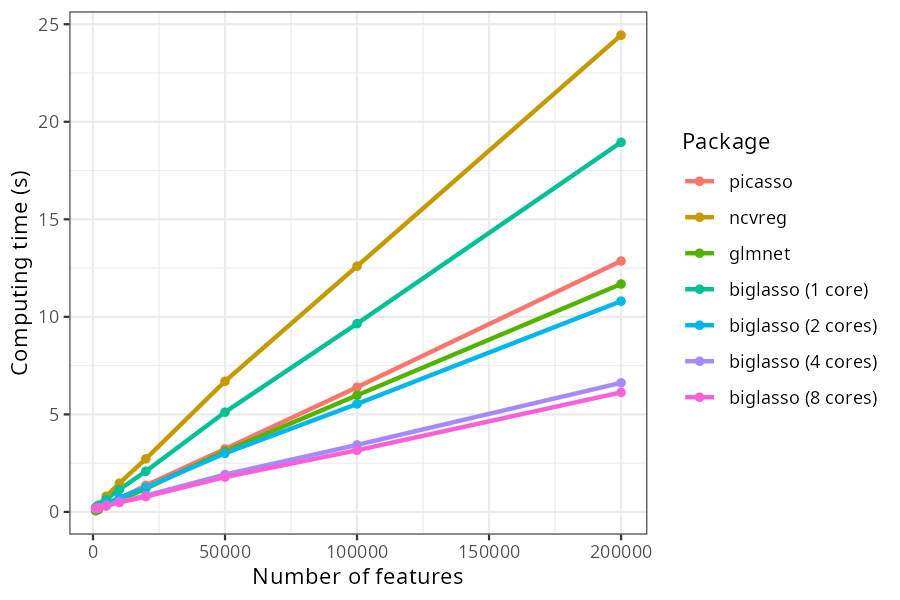
Same design as the linear-regression sweep above, but fitting
family = "binomial" models.
- Varying
n: At the largest simulated size,biglasso(1 core) is not the fastest package here - it trailsglmnetby a factor of 1.5; with multiple cores (biglasso (8 cores)),biglassois the fastest option overall, 2.2x faster than the fastest single-threaded package (glmnet). - Varying
p: At the largest simulated size,biglasso(1 core) is not the fastest package here - it trailsglmnetby a factor of 1.6; with multiple cores (biglasso (8 cores)),biglassois the fastest option overall, 1.9x faster than the fastest single-threaded package (glmnet).
Real data
RCV1 (in the default all target) plus Gisette, NEWS20,
and P53 (opt-in via logistic_real_extra, kept opt-in purely
for download size - 22-191MB each).
| Method | rcv1 | gisette | news20 | p53 |
|---|---|---|---|---|
| picasso | 12.26 (0.054) | 1.80 (0.005) | 14.41 (0.212) | 6.98 (0.037) |
| ncvreg | 16.17 (0.052) | 4.18 (0.022) | 28.81 (0.342) | 18.46 (0.020) |
| glmnet | 8.34 (0.021) | 1.44 (0.008) | 12.63 (0.028) | 5.27 (0.013) |
| biglasso | 10.34 (0.034) | 1.94 (0.011) | 20.02 (0.094) | 9.94 (0.011) |
biglasso does not have the fastest mean time on any of
the 4 real logistic-regression data sets tested here -
glmnet did. glmnet in particular has gotten
faster since the original biglasso paper was published, and on real data
at these sizes it’s often competitive with or faster than
biglasso. biglasso’s advantage on real data is
primarily memory (see below), not always raw speed.
Memory efficiency
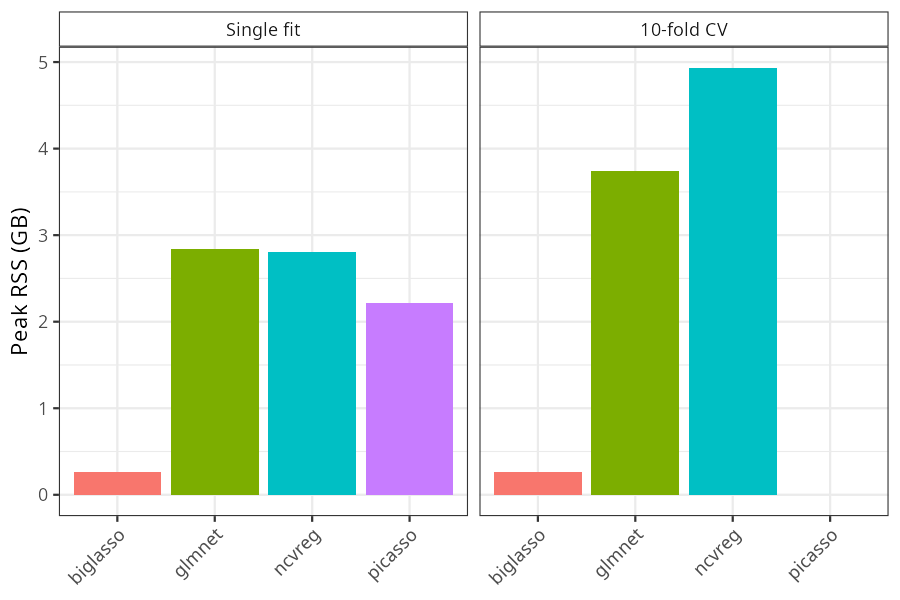
biglasso never copies X into ordinary R
memory - it operates on a file-backed big.matrix
throughout. To quantify the effect, we simulate a 1,000 x 100,000 design
matrix (raw size 0.75 GB) and measure peak resident set size (RSS) via
/usr/bin/time -v for a single fit and for 10-fold
cross-validation (picasso has no cv.*
function, hence no CV bar for it below).
| Package | Single fit (GB) | 10-fold CV (GB) |
|---|---|---|
| biglasso | 0.26 | 0.26 |
| glmnet | 2.84 | 3.74 |
| ncvreg | 2.81 | 4.93 |
| picasso | 2.21 | NA |